Lost Pigeon Radio (transcript)
For anyone who needs or wants to read the piece instead of, or as well as listening, this is the text:
Welcome to Lost pigeon Radio. Please listen to hear descriptions of The Paper Factory and Hidden Door festival 2026.
On the western edge of Edinburgh, beside the ring road, and the tramlines and railway at Edinburgh Gateway Station, lies a sprawling complex of abandoned industrial buildings: the former Saica paper and cardboard manufacturing plant. It’s a a fifteen-acre maze of warehouses, factory floors, office blocks, conveyor systems and outhouses. So vast that if it was a carpark there would be space for 3000 parked cars, it’s a whole small town.
It was a closed-down world inhabited by pigeons and for years the site sat mostly untouched by humans. The former life of the factory remains eerily suspended inside it: noticeboards still carrying instructions, health and safety manuals left open in dust, steel-capped boots still waiting in locker rooms beside family photographs and forgotten coats. Machinery stands abandoned mid-process beneath layers of dirt and pigeon shit.
Until Hidden Door brought hundreds of artists, builders, musicians, architects, technicians, sound engineers and volunteers to get the factory working again.
Over the first weekend in June it hosts five days of art, performance and music.
The following descriptions will move through three principal spaces within the complex: the Factory Floor, the Link and the Long Room. These three spaces link together consequently and viewed from above they are like two full size football pitches bridged together by a swimming pool. To walk from the entrance of Hidden Door to the main music stage at the far end of the long room would take a brisk five minutes. To wander could take you hours, due to the density of art, performance and fascinating architectural ruins. The floors is concrete throughout and although mainly level it can be uneven in places, with barriers obstructing accidental access to dips and pits. There is one set of stairs about halfway across the site in the long room. For stair free access to the the long room beyond, ask the stewards for access vis outside ramp.
Throughout the site the lighting is atmospheric and rarely bright, with contrasts and different colours. These descriptions will begin as thumbnail descriptions before expanding into more atmospheric and poetic observations of the architecture and the strange ecosystems that now inhabit it.
THE FACTORY FLOOR
The factory floor is a vast open-plan industrial landscape, home to the dance and spoken word performance spaces, the bar, the 19canteen and many art installations. Grimy, cavernous and littered with looming hulks of dead machinery, the factory floor feels part subterranean terrain, part steam-punk fever dream. Pools of daylight leak through filthy roof glazing illuminating abandoned machines and massive art installations. Live performances occupy pathways once used for industrial production. Pigeons dart from the rafters . The entire space feels simultaneously abandoned and awakening.
THE LINK
A transitional space connecting the factory floor to the long room beyond where the main music stage is situated. Split-level, brightly coloured and unexpectedly intimate after the scale of the factory floor. Green enamel flooring below. Warm yellow light above. Red- painted surfaces and conveyor platforms create the feeling of passing through the internalorgans of the building — a brief architectural inhale between two monumental chambers.
THE LONG ROOM
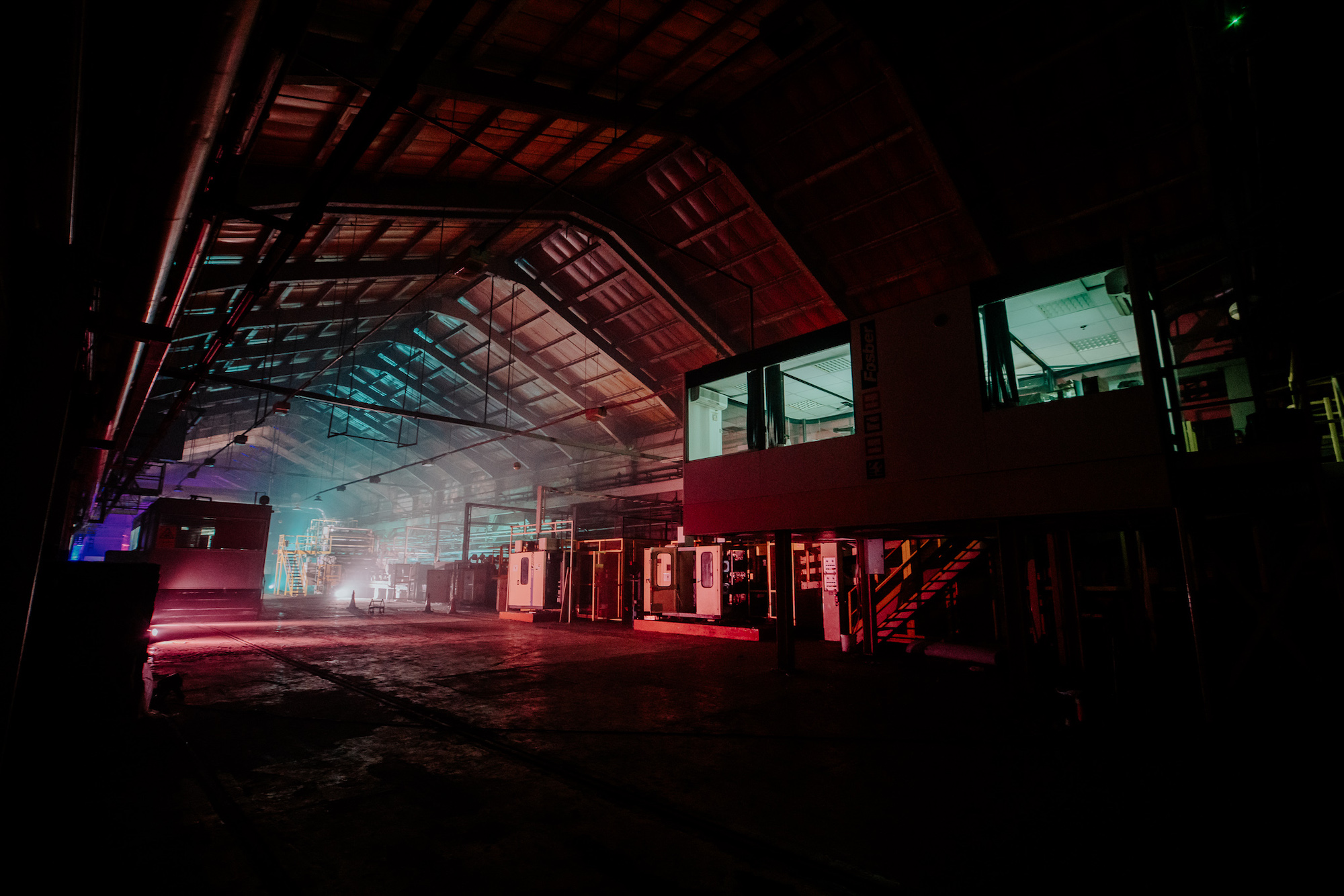
The cathedral of the site, this where the main music stage can be found and also the machine room. A colossal warehouse space four empty stories high, so tall you have to break your neck to see the ceiling. Dark and echoing, the room resembles the upturned hull of a huge vessel, its pitched wooden ceiling four stories above like an upside down boat. Conveyor belts, suspended walkways, ladders, site offices and looming machinery line the walls, as high skylights leak shafts of light.
ENTRANCE
The entrance to the factory feels almost deliberately ordinary. A two story white rendered industrial building sits behind galvanised steel fencing. Two long lines of dark windows run horizontally across the facade. It has the appearance of a municipal depot, ferry terminal or anonymous business park: an exhausted air of postwar industrial modernism and a slight whiff of the naval, like a art deco boat a sail on a tarmac carpark full of food stalls. Through the small front for and into a small unglamorous foyer with a central staircase and the box office on the left processing you forward into the festival. Options unfold to your left and right into small mazes of former administrative rooms . These are small office size rooms with low ceilings, and would have been filled with factory management and then dusty filing cabinets, noticeboards and abandoned desks. For the festival they have been repurposed into visual art installations to the right and music spaces to the left. You can also go up to the first floor via a central spiral staircase in the foyer to visit an art installation and be spit out down a second staircase that takes you into the factory floor,
towards performance and sound.
It’s a deliberately disorientating entrance, a prelude meant to compresses the body and challenge the imagination before the building suddenly opens outward into impossible scale. The experiential equivalent of being blindfolded and spun round, a narrow throat before a cathedral opens.
Occasionally a pigeon appears unexpectedly at the end of a corridor beneath flickering strip lights, standing like a mistaken office worker.
THE FACTORY FLOOR
Leaving the offices behind through the central door and past the bar and the building suddenly opens up infront of you . The Factory Floor is a vast open-plan industrial landscape beneath dirty skylights, stretching almost beyond visibility Roughly the size a full size football pitch, the space is grimy, cavernous and littered with performance areas, art installations and looming hulks of dead machinery, like a steam punk fever dream.
If you enter the factory floor space at 6 clock, then walking straight across the centre of the room to 12 clock will take you to the entrance to the link and the long room beyond. Linger and explore and you will find the dance and performance stages between 6 and 9, spoken word between 9 and 12 and constellations of art installations throughout and particularly clustered between 12 and 6, on the right hand side of the room. If you are listening to this in the nineteen canteen, then you are towards five clock, in the back half of the room.
Repeated yellow columns divide the visual field into grids of space so that you never quite see the building all at once. The ceiling feels strangely low despite the enormous scale because the eye is constantly interrupted. Seven columns across. Ten long. Perhaps
seventy altogether. yellow steel columns arranged with near-military regularity, dividing the enormous room into avenues, bays and chambers. Thick yellow girders crossed overhead in long horizontal bands, interrupting the eye wherever you looked so that the whole factory seemed overlaid with a geometric framework. Depending on your perspective, the columns either rose from the floor like trunks in a forest or descended from the rafters like supports pinning the building together.
The rafters are holding up a jig saw of pitched roofs, some running perpendicular to the length of the space and others running adjacent. Hundreds of metal a frames, crisscrossed by wires, tunes, pulleys and springs, a dense metal canopy. Above them, skylights thick with moss, rain stains and pigeon residue filter daylight unevenly into the room. Pools of illumination drift across the floor while farther reaches dissolve gradually into shadow.
The floor remember machinery through absence and rectangular pits descend deep into the concrete where giant industrial systems once stood. Painted markings in yellow, white, red and green continue attempting to organise invisible workers resembling fragments of a map or the floorplan of some dismantled city. Decay has layered itself over everything. The walls of the factory floor are layers of off white peeling paint to expose 1 hundred year old brick. Water has entered through cracks in the roof and dried again, leaving mineral blooms and strange evaporated stains across the concrete. Oils, paint, adhesives and
chemical residues has soaked into the surface over decades.
The machines remain scattered throughout the floor like extinct robot dinosaurs. A huge white printing press sits near the centre of the room , the size of a truck. Other machines nearby have less obvious purposes and loom with a combination of pulleys, vents and disconnected systems. Smaller machines hang from the ceiling on chains and struts, half- disassembled, trailing cables and switches. Metal cages, ducts, springs, pulleys and extraction fans remained suspended overhead with no immediately obvious purpose, as though parts of the factory had been amputated while the skeleton stayed behind.
Everywhere there is remnants of instruction: hazard signs, directional markers, hanging labels naming zones long since obsolete.
And somewhere high in the rafters, beyond the yellow girders and dirty skylights, something still watched from the dark.
THE LINK
At the far end of the Factory Floor sits the Link, a transitional loading space joining the factory floor to the Long Room beyond. Compared to the monumental scale of the Factory, the Link feels surprisingly intimate. Split across two levels, joined by a large
conveyor platform capable of lifting goods upward between floors.
A staircase of eleven metal steps on the right hand side rises into warm yellow light above. Red and green painted flooring, light walls and strips of large windows towards the top of the walls make the space feel unexpectedly connected to daylight again after the subterranean atmosphere of the factory floor. The conveyor systems threading through the space resemble giant mechanical organs linking one atmosphere to another. The Link behaves like an architectural inhale, a momentary pause before the darkness and verticality of the long room beyond.
THE LONG ROOM
The room itself is immense. One gigantic industrial shed stretching into darkness beneath a pitched roof shaped like the hull of an upturned ship. It feels possible to fit a cruise liner inside it. Or a whole street of houses. Forty houses perhaps, with a road running between them. The scale becomes absurd. Standing inside it makes you realise how huge ships actually are.
Unlike the gridded intimacy of the factory floor, the long room is one continuous volume. A single dark nave. A cathedral of industry. The windows high along the outside wall have mostly been blacked out with sheets of dark
fabric, allowing only thin shafts of light to leak around the edges. Most of the illumination comes from industrial lights suspended from the rafters: warm yellow in the centre, colder white at the ends. The entire room glows dimly amber. Industrial machinery lines one side of the room: conveyor systems, rollers, cages, walkways, raised site offices perched on stilts and reached by ladders.
Everything feels dormant but not dead.
At the far end of the room is the main stage and a bar to the right. And above it all the pigeons coo constantly. Their sounds echo around the room like ghosts. Deep resonant coos. Tiny squeaks from hidden nests high in the roof. Sudden explosive wingbeats ricocheting across the metal hull of the ceiling. When they fly together their wings produce a strange staccato cackling noise that sounds almost like laughter.
You can understand why people once thought abandoned spaces were haunted. Anywhere left alone long enough becomes habitat. Caves. Castles. Ruins. Empty houses. Factories.
The cracks and ledges become opportunities for life.
NOTES FROM THE RAFTERS
Part of Lost Pigeon Radio, by Juliana Capes for Hidden Door Festival 2026
Seen from a distance we appear grey,
In flight we flash with sudden white diagonals.
our necks shimmer green and purple like tiny aurora borealis
We fly around this monumental doo’cot .
built for us by you; like you always have for centuries
You gave to us these inside cliffs and caves
A soft sheltered expanse of sky.
craggy ledges under gentle weather,
dust filled light shafts and oil filled dew pools
here, our home our Safety.
This gift now belongs almost entirely to us
The metal mountains and beasts are our thrones.
We are in the cracks between girders, in dark openings near the skylights, in warm ledges above where the air rises thick
with dust.
The rafters are branches. The skylights are weather. The girders are pathways. The factory is our terrain
We move through all of it instinctively, born on swells from sleeping steel skeletons that hold vast electrical memories.
Old systems remain embedded in the architecture like ghosts inside a nervous system.
You only see absence and only with eyes.
But we sense with our guts and brains and livers the magnets of old computers,
This factory is full of invisible forces.
Every time your music plays it forces warm air , waves of magnetism carrying
feathers, spores, dust and towards nests. Radio static moves through the walls.
Electricity hums through old systems buried beneath concrete. Magnetic fields pass
silently through steel beams and machinery and through our systems
The factory speaks to us constantly through magnetism and our bodies answer
without language.
We are masters of navigating overlapping systems:
iron inside our bodies, proteins behind our eyes react
invisible magnetic lines become folded into vision.
You build radios and towers and wireless systems to imitate what is quietly us, your
ancient messengers
Sometimes when we circle upward through the factory it feels as though we are swimming through layers of unseen power. Maelstroms and tumults circling through metal canopies drawing swirls into grids, drawing calligraphic flourishes around rectangle and square.
When you arrive, we explode upward together into the rafters. Wingbeats ricochet around the room. Dust rises. Feathers drift through shafts of light.
Then eventually we settle again because we know you are temporary.
We inherited this place 20 generations ago from you, it belongs to our ancestors
You are our strange companions, past lovers, amnesiac companions. You see us every day and rarely notice us. We remember you.
We sit outside your windows, walk through your train stations, eat from your bins, sleep beneath your bridges,
watch you from roofs and statues and warehouses.
Not quite wild enough to feel natural, not tame enough to feel domestic. Despite living with us for thousands of years, you forget all you know about us. You rarely see our chicks. Rarely notice our nests.
We do not sing like other birds.
You here feels like weather arriving. The doors are now open, there are larger gaps for sound and light and small feathered bodies to come in,
You have arrived in a riot of colour and noise. An incoming weather system
You are temporary flocks moving through our ruins. You illuminate dead machines and call it beautiful.
The factory is the floor of a wide forest, so wide that distance is uncertain
A full size field below a canopy of metal rafters, roof braces. The factory floor is a pine forest floor, the emptiness under canopy, the filtered light, an interrupted field of vision, opportunities to hide , to line up with a blocked sightline and wait when to dive into the cocoon of dusty air. The clearings in light and the growth of colour and form. Water pools in places and gives life.
wings
cackle into flight
Drawing lace loops
In the dusty air
Fringing the rafters
With staccato missions
We have important jobs to do
Weaving around the grid
Moving with industrial logic.
Short flights.
Purposeful hops.
Repeated routes.
Commuting
Nest to food
Food back to beam.
Beam to floor.
Working the factory floor. This is a place of industry, shelter or survival. It’s not lost and neither are we. You used to build us houses as part of yours. You used to protect our shit as the fertile gold dust it is. Use it to grow your food. Now you fear it
and clean it off your monuments.
Imagining that all through this corrugated metal doo’cot our shit is powdered acid, a grey dust capable of dissolving dislocated machinery and waste into a garden , a meadow. Eventually these concrete floors would crack and lakes would pool, a
sheltered paradise for us.
Fertile ground
Navigation is a form of devotion about knowing exactly where another living body exists within your world
We can sense the earth itself . We mate for life. We are the swans of the air, rats with wings. We are elegant romantic dancers, beautiful lovers of the factory floor.
Romeos and Juliets calling through the expanse. Will you come to me? Will you stay with me? Will you be mine for ever in this magical place. Of shelter and warmth. Of protection.
Our love is a Gravitational force
A constant locating of another body within invisible space
The shimmer around our necks is not decoration. It is a signal moving through light.
An announcement. I am here. I survived another night. Come closer. I want to love
And so
our curving wings
carry us aloft.
Afloat on the curve of
our together space.
Magnetic magic.
Finding each other.
Finding our route.
Together making the next
generation, as we must.
And they will know
their way, because
we are
wherever we move.
our lives are saturated with attachment.
constant watching-over.
constant following.
Wherever she goes, he goes. Wherever he lands, she lands
We lean into each other beneath the rafters.
We preen each other carefully around the eyes and neck on our shitty ledges
We wrap wings around each other while resting on truncated pipes
We nuzzle beaks with closed eyes.
We stand silently side by side watching weather move through broken skylights.
We dance for hours across the concrete floor, necks shimmering oil-green and violet in the exhausted light, circling with ridiculous determination, trying desperately to be chosen.
There is a nest high up in the long room, tucked against a ledge near the ceiling.
Babies are living there now. Small grey bodies pressed together beneath scraps of feather and straw. Their squeaking carries down through the rafters constantly — thin hungry sounds threading through the factory air.
We raise our young, protect them till they are grown, Feed them from our own throats.
This places amplifies our love.
Calls echo through steel caverns, reverberating our need for each other.
Courtship spirals upward beneath hanging cables and roof braces.
Mesotocin and vasotocin flood our breasts and power our wings
It is a place of love. A part of the world of love. Hear the laughter in our wings soften machine edges. Imagine the soft swelling of our breasts inflating corrugated metal, our insistent coos pushing hot air into the factory and ballooning the corners.
This was Lost Pigeon Radio by Juliana Capes. You can find out more about her, and this piece, on the main page for the event, linked below.